BOGOR, INDONESIA, 24 September 2026 – The palm oil industry must increasingly demonstrate not only its sustainability commitments, but what those commitments deliver on the ground, as sustainability becomes ever more closely linked to market access, business resilience and long-term competitiveness.
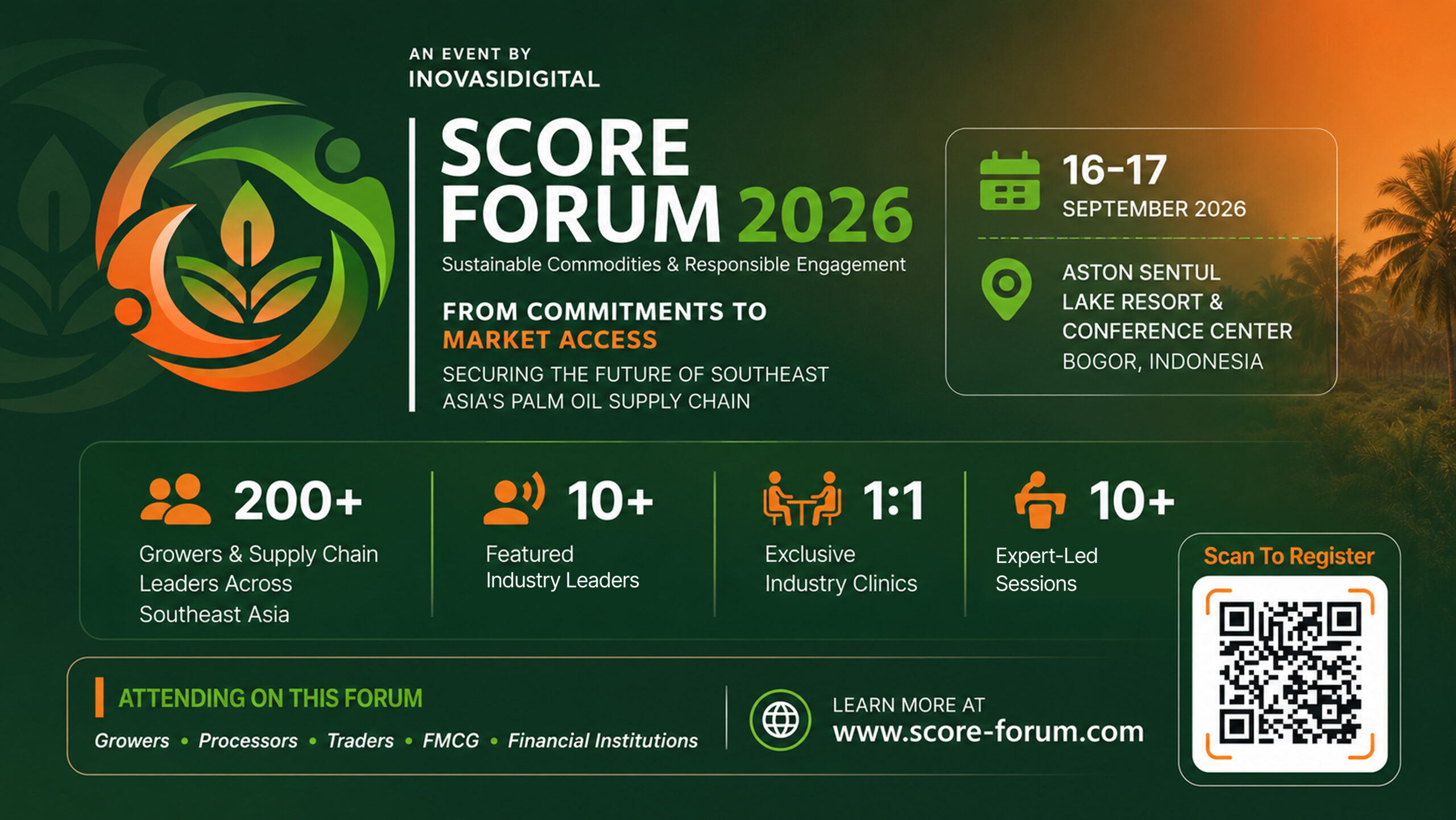
This was a key message emerging from the Sustainable Commodities & Responsible Engagement (SCORE) Forum 2026, held in Sentul, Bogor, from 16 to 17 September under the theme “From Commitments to Market Access.”
Hosted by Inovasi Digital, the Forum brought together close to 190 participants from Indonesia and Malaysia, including growers, processors, traders, global buyers, government and industry organisations, certification bodies, smallholders, and sustainability and technology specialists.
Across two days of plenary discussions and practical workshops, participants examined how the industry can respond to rapidly evolving regulations, buyer expectations and sustainability requirements while keeping responsible production practical, inclusive and commercially viable.
Ihwan Rafina, Senior Technical Advisor of Inovasi Digital, welcoming participants and officially launching the SCORE Forum 2026 in his opening remarks.
Opening the Forum, Ihwan Rafina, Senior Technical Advisor at Inovasi Digital, highlighted how the foundations of palm oil competitiveness are evolving. Alongside price, productivity, volume and quality, companies are increasingly expected to demonstrate where their palm oil comes from, whether it has been legally and responsibly produced, and whether sustainability claims are backed by credible evidence.
The Forum featured keynote perspectives from Dr Musdhalifah Machmud, Deputy Secretary General of the Council of Palm Oil Producing Countries (CPOPC); Luke Mahony, CEO of PT Danantara Sumberdaya Indonesia (DSI); and Hisham Hussain, Head of Trade Section, Economics and Industry Development Division, Malaysian Palm Oil Board (MPOB).
Other speakers represented the Roundtable on Sustainable Palm Oil (RSPO), Musim Mas, Bumitama Agri, Yayasan FORTASBI Indonesia, Unilever, Apical Group, SD Guthrie, Wilmar International, Fuji Oil Group and Indonesia’s Geospatial Information Agency (BIG).
From compliance to measurable outcomes
Across the discussions, a clear theme emerged: sustainability can no longer be treated as a separate compliance function. It is increasingly connected to supply reliability, productivity, trusted commercial relationships, market access and long-term business resilience.
Participants also explored the industry’s transition from demonstrating policies and processes to delivering measurable outcomes. Traceability and monitoring can show where commodities originate and what is happening within supply chains, but information is ultimately a means to an end. The challenge is to use that information to identify risks, engage suppliers, support improvement and determine whether action is delivering results.
This also requires stronger connections between public and private systems. As governments play a growing role through regulation, standards, authoritative data and public infrastructure, participants highlighted opportunities to connect these systems with the supply-chain information, relationships and implementation experience held by companies and other private initiatives.
Keeping smallholders connected to responsible markets
Smallholder inclusion was another important thread throughout the Forum. Participants stressed that traceability should do more than identify the source of palm oil, but should also help identify where farmers need support to meet evolving sustainability and market requirements.
Keeping smaller producers within responsible and market-ready supply chains will require practical approaches to data, capacity building and long-term engagement. Participants highlighted the importance of creating credible pathways for improvement rather than relying on exclusion as the default response to risk.
From discussion to action
Co-presenters for the workshops on Day 2 - Chin Kaixiang from Bunge Loders Croklaan, Danial Adha from KLK and Suwanto Gullit from Unilever with representatives from ID. The workshops covered topics such as Monitoring and Traceability, EUDR, and Recovery and Re-Entry.
The second day brought these issues down to practical implementation through workshops on the EU Deforestation Regulation (EUDR) and other reporting requirements; forest and landscape protection, recovery and re-entry; and traceability and monitoring. Discussions focused on meeting increasingly specific regulatory and market expectations while avoiding unnecessary duplication, and strengthening risk assessment, supplier engagement and follow-up.
The Forum concluded with a Plenary Synthesis and Call to Action, emphasising shared responsibility across producers, processors, buyers, governments and other stakeholders. Participants called for greater alignment between systems, better use of available data and more coordinated action capable of delivering measurable improvements on the ground, while ensuring that smallholders and other supply-chain actors are not left behind.
Closing the Forum, Eric Wakker, Associate Director of Inovasi Digital, reflected that the industry has become much better at seeing what is happening in its supply chains. The next challenge, he noted, is to become equally good at changing what happens as a result.
For participants, SCORE Forum 2026 provided not only an opportunity to understand emerging requirements, but also a space for candid conversations about the realities of implementation across the supply chain. Feedback indicated that many participants found the topics and exchanges closely reflected what they are experiencing on the ground, with strong interest in continuing the conversation at the next SCORE Forum in 2027.
SCORE Forum 2026 reinforced a clear direction for the industry: future-proofing responsible palm oil will depend not only on making commitments, but building the evidence, systems, relationships and practical capacity needed to turn those commitments into meaningful action and sustained market access.
Group photo with some of the speakers and participants on Day 1 of the SCORE Forum 2026.