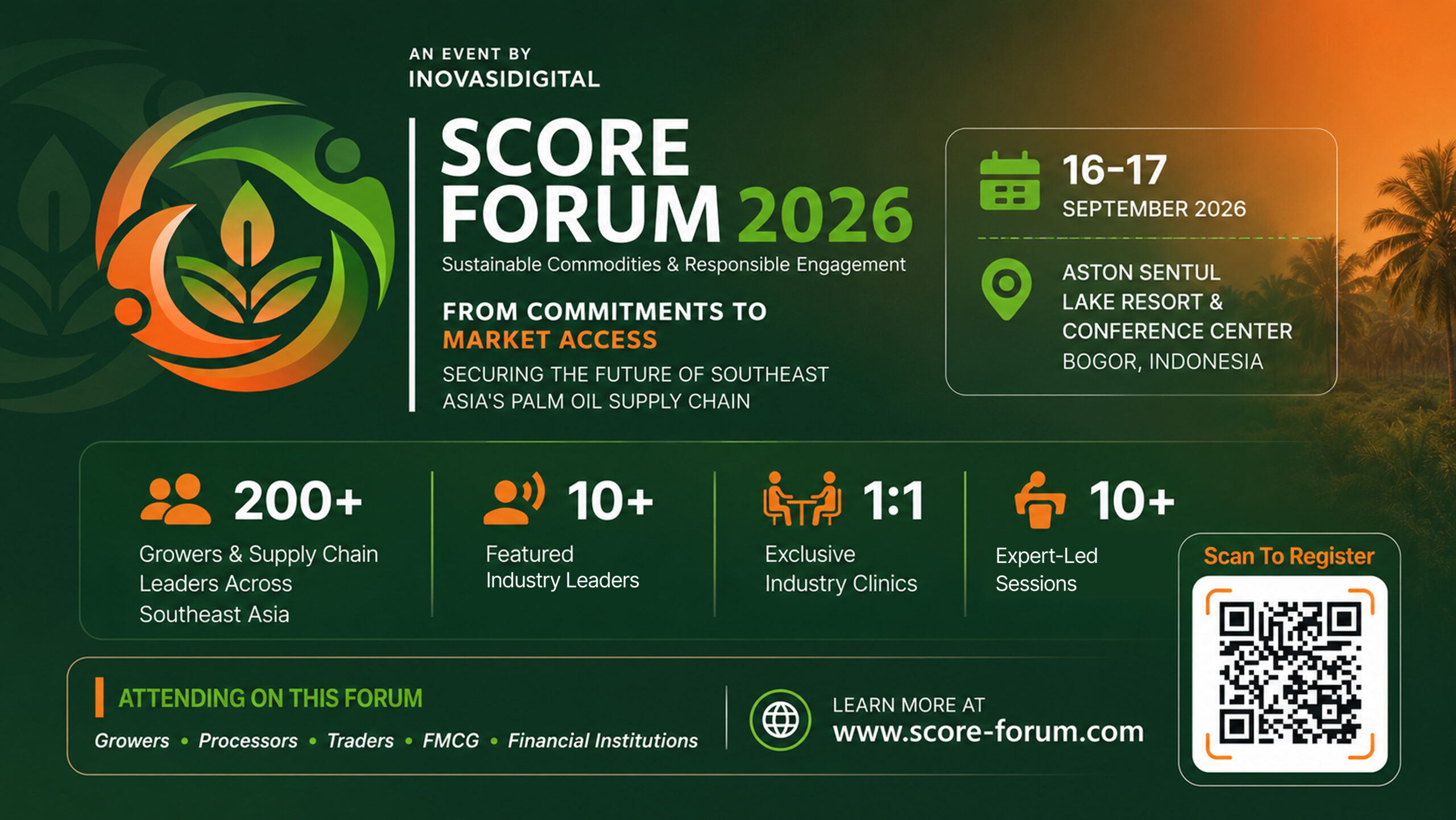
Bogor, Indonesia — The opening keynote speeches at Sustainable Commodities and Responsible Engagement (SCORE) Forum 2026 set the direction for two days of discussion on the future of Southeast Asia’s palm oil supply chain, bringing together perspectives from producing countries, export governance, and industry development.
Across the three keynote addresses, a common message emerged: maintaining access to global markets increasingly depends on the ability of producing countries and industry actors to demonstrate credible sustainability performance, strengthen transparency and traceability, and ensure that evolving market requirements translate into practical improvements across the supply chain.
The keynote session featured Dr. Musdhalifah Machmud, Deputy Secretary General of the Council of Palm Oil Producing Countries (CPOPC); Luke Mahony, Chief Executive Officer of PT Danantara Sumber Daya Indonesia (DSI); and Hisham bin Hussein, Head of Trade Section, Economics and Industry Development Division at the Malaysian Palm Oil Board (MPOB).
Strengthening the Voice of Palm Oil Producing Countries

Dr. Musdhalifah Machmud highlighted that palm oil producing countries should be proactive in shaping the sustainability frameworks and market expectations affecting the industry in her keynote speech.
Opening the keynote session, Dr. Musdhalifah Machmud highlighted the strategic role of palm oil producing countries in global food security and the importance of stronger cooperation among producer nations.
She noted that Indonesia, Malaysia, and Thailand collectively account for more than 87% of global palm oil output, while palm oil provides a significant share of the world’s vegetable oil supply using considerably less land compared with alternative oil crops.
Against this backdrop, she stressed that producing countries should play an active role in shaping the sustainability frameworks and market expectations affecting their industries.
“Regional and international cooperation is not optional; it is foundational.”
Through CPOPC, she explained, producer countries are working to strengthen their collective position while developing common approaches to sustainability. One example is the Global Framework of Principles for Sustainable Palm Oil (GFP-SPO), which she described as a common baseline connecting national standards such as ISPO and MSPO alongside other sustainability frameworks.
Smallholder inclusion was another central part of her message. In Indonesia alone, she said, 2.6 million independent smallholders manage around 41% of the country’s total palm oil area. Sustainability requirements, she argued, therefore need to recognize the realities faced by producers on the ground.
“A sustainability policy that excludes smallholder farmers is not sustainable.”
She pointed to replanting, improved planting materials, and better agronomic practices as important pathways for increasing productivity and farmer incomes without expanding agricultural land.
Her remarks also emphasized constructive engagement between producing and consuming markets, including efforts to address implementation and traceability challenges through dialogue between Indonesia, Malaysia, and the European Union.
Building Transparency into Indonesia’s Commodity Exports

Luke Mahony explained Indonesia’s evolving export governance and how it creates better visibility and transparency across the export ecosystem.
The second keynote shifted the discussion from producer-country cooperation to Indonesia’s evolving export governance.
Luke Mahony, CEO of PT Danantara Sumber Daya Indonesia (DSI), explained that DSI is entering an already established ecosystem involving government institutions, producers, exporters, traders, surveyors, and other stakeholders.
He emphasized that DSI’s role is not intended to replace these actors or introduce unnecessary complexity into existing processes.
“Our purpose is quite simple. It’s about creating better visibility and transparency across Indonesia’s strategic commodities and across the export ecosystem.”
According to Mahony, significant volumes of export-related data already exist across different institutions and systems. DSI’s role is to connect and analyse this information to build a more complete picture of Indonesia’s commodity exports. Better visibility, he said, can help identify anomalies related to issues such as under-invoicing, transfer pricing, discrepancies in export volumes, and other potential sources of value leakage.
But transparency, in his framing, is not only about oversight. It also needs to contribute to a competitive and trusted export environment.
Mahony stressed that whatever systems DSI develops should remain transparent, predictable, and non-disruptive to legitimate business, while ultimately helping Indonesia strengthen price transparency, identify commercial opportunities, and capture greater value from its natural resources.
With DSI still at an early stage of implementation, he said its success should ultimately be measured not by how much data it collects, but by the value created for Indonesia, producers, and exporters.
His closing message reinforced the need for collaboration:
“We are here to listen, we are here to learn, and most importantly, we’re here to build this together.”
Connecting Sustainability with Market Competitiveness

Hisham Hussain stressed that national systems and top-down requirements alone cannot deliver sustainability unless smallholders are able to participate.
Representing the Malaysian perspective, Hisham bin Hussain of MPOB brought the discussion directly to the relationship between sustainability and market competitiveness.
He argued that sustainability has moved beyond being treated simply as a compliance issue and has become increasingly central to maintaining competitiveness in global markets. For Malaysia, he identified productivity, assurance, and market confidence as interconnected foundations for maintaining market access.
Central to this approach is PALMS 2030, MPOB’s strategic framework built around five pillars: productivity, automation, low-carbon development, marketability, and sustainability. Hisham explained that the framework combines scientific research, biotechnology, circular-economy approaches, mechanisation, and precision agriculture to improve productivity while addressing environmental and labour challenges.
Traceability and credible assurance also featured prominently in his keynote.
Hisham outlined Malaysia’s efforts to integrate national digital systems covering physical supply movements, plantation geolocation, and sustainability certification records. These systems are intended to strengthen end-to-end visibility from smallholders and estates through dealers, mills, processors, and ultimately export markets.
At the same time, he stressed that national systems and top-down requirements alone cannot deliver sustainability unless smallholders are able to participate. Through its extension network, MPOB is therefore expanding support for smallholders in areas including technology adoption, productivity, certification compliance, and connections to commercial supply chains.
From Commitments to Market Access
Although approaching the sector from different institutional perspectives, the three keynote speeches converged on a common direction.
Market access is increasingly connected to the credibility of the systems behind the commodity. Producer countries need a stronger role in international sustainability discussions; governments need better visibility and governance across commodity trade; and industry actors need traceability, assurance, and sustainability systems capable of demonstrating performance from production through export.
At the same time, these systems need to remain practical and inclusive—particularly for smallholders and other actors operating at the upstream end of the supply chain.
This reflects the central theme of SCORE Forum 2026, “From Commitments to Market Access.” The challenge is no longer simply to establish sustainability commitments, but to translate them into credible systems, stronger governance, and implementation on the ground that can support both responsible production and continued access to global markets.
As Dr. Musdhalifah emphasized in her opening remarks, forums such as SCORE should go beyond discussion toward implementation across the respective roles and responsibilities of stakeholders.
The keynote session therefore provided a clear starting point for the discussions that followed at SCORE Forum 2026: how Southeast Asia’s palm oil sector can strengthen its position in global markets while building supply chains that are more transparent, resilient, inclusive, and demonstrably sustainable.